
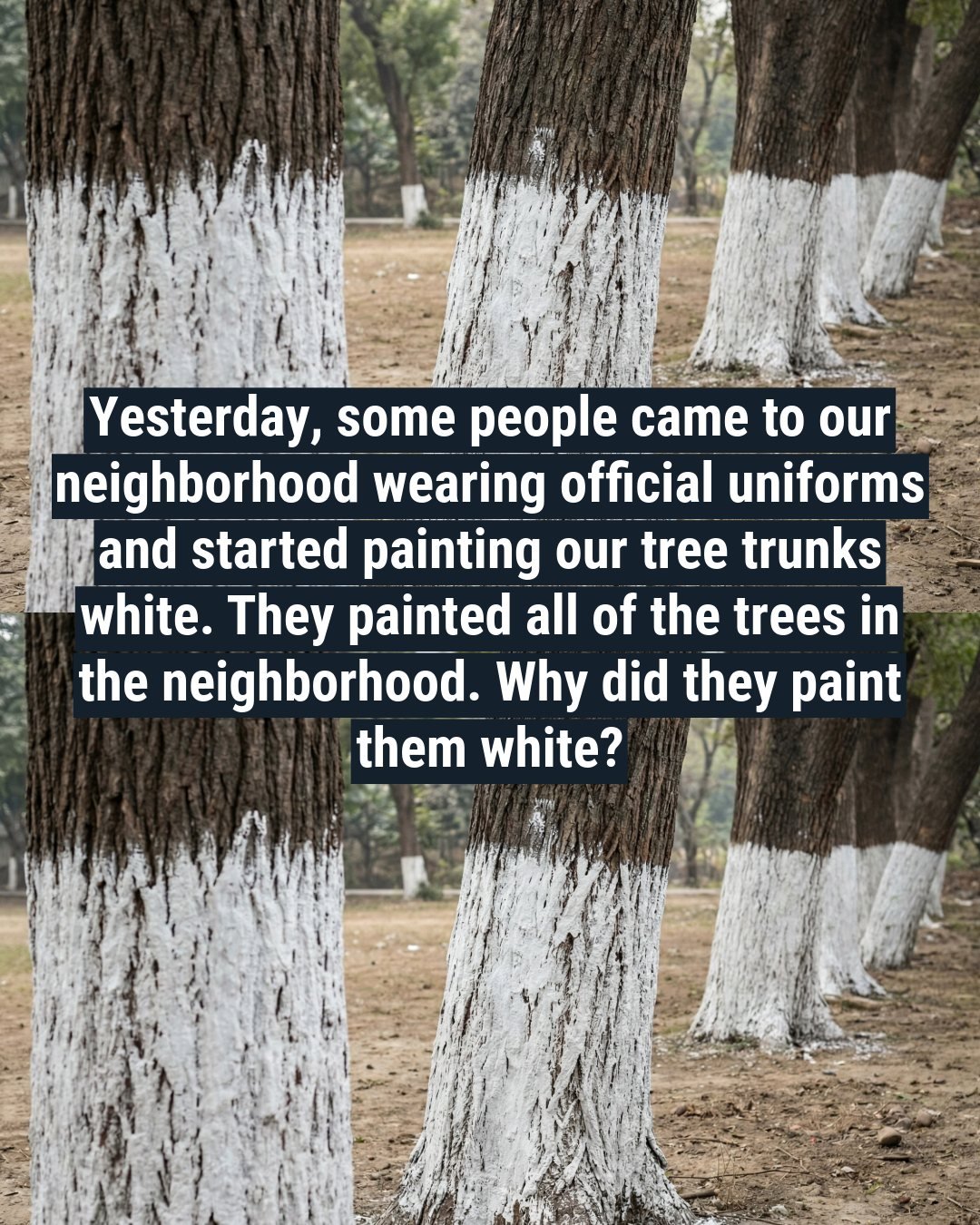

For years I have come across them on country roads and in orchards — trees standing upright in winter nakedness, their trunks wrapped in a soft white band, as if they had been dipped in fresh snow.
I would ask myself: what does this mean? Is it a warning? A clue? A message intended only for those who know how to decipher it?
Actually, it’s none of that.
It’s something much more tender.
It’s attention.
Not a code, but a safety measure.
You may have already seen other markings painted on trees: orange for felling, purple for “private property”. These are signals, both practical and administrative.
But white?
White is different.
White is not for humans.
It is for the tree.
In winter, when the sun is low and bright against a pale sky, something silent and dangerous can happen: sunburn.
Here’s how it happens:
During the day, the sun’s rays warm the dark bark, causing it to swell slightly.
Then night falls. The temperature drops sharply.
The bark cools too quickly. It contracts.
And in this sudden change, it can split. Crackle. Peel away.
These wounds may seem insignificant, but they are invitations – to parasites, to disease, to decay.
A tree, in its stillness, struggles to stay alive.
The white coat: nature’s gentle armor.
We therefore offer our help.
A layer of diluted white latex paint — nothing sophisticated, nothing chemical — covered the trunk, from the base to below the lowest branches.
Why white?
Because it reflects light.
Because white doesn’t absorb the sun’s heat like dark bark does.
Because it softens the transition—from the heat of the day to the coolness of the night—giving the tree time to adapt, instead of breaking.
CONTINUE READING IN THE NEXT PAGE
